23 November 2014

When Your Plate is Too Full - how to say no to all the rushing

The theme in my yoga classes this half-term is slowing down. We are moving slowly between the poses and holding them for a bit longer too.  Staying in the postures builds strength, stamina, resilience and awareness whilst allowing us time to pay attention to the breath, release any unnecessary tension and align the body correctly. 

Slowing down is especially important at this time of year as we move towards the Christmas period when things inevitably get hectic.  Here's an article from Leo Babauta from zenhabits.net with some wise words about slowing down when you feel that it's all just a bit too much.

When Your Plate is Too Full
By Leo Babauta
Do you sometimes (or always) feel like you have too much to do and too little time to do it?Consider an email I got from a student the other day:

“… as the semester goes by, the harder it is to keep up with school. The thing is, I know I’d be able to do it if I didn’t have any extracurricular activities. I have a weekend job where I teach youths, a youth group where I currently lead social justice, and I was just asked by someone to lead prayer group. Right now, the only way to do everything is to sleep less and work more, but I noticed that I can’t do much when I haven’t gotten much sleep. I wanted to take care of my body as well so I’ve been sleeping normally these past few days. Now I’m behind everything again; I have two big assignments due and midterms next week.”

I know this feeling, because that’s how I felt before I started simplifying my life. I was being pulled in all directions, and never had enough time for everything I needed to do. I wanted to do a great job with each role I’d taken on, and felt I could do it, but really I was doing a bad job at everything because I was stretched too thin.

To this student, and to everyone else who feels this way, I’d say this: your plate is too full. You have too much going on. The only answer, unless you want your health to decline (and that’s not good for anyone), is to start saying No.

The Whys of Saying No
You have to say No to at least a couple things on your list: say No to prayer group and the youth group, so that you can say Yes to school and the job. For anyone else reading this, you might have to say No to certain work projects, or community groups, or committees or boards or parent-teacher organizations or coaching sports or some other worthwhile activity. I know, it seems horrible to say No when these are very worthy things to do. It kills you to say No.

But the alternative is that you’re going to do a bad job at each one, and be stressed beyond your limits, and not be able to focus on any one. You won’t be getting enough sleep, your focus will get worse because of a lack of sleep, and stress will compound that problem.

We stay in this state because we really want to do it all. We have this idea that we can be great at everything, and succeed at all that we try. But we are human, and we have limits, and we have to let go of this idea of doing everything and doing it well. You’re either going to do a couple things well, or do everything poorly.

Do a Couple Things Well
Ideally, you’d find complete focus and do one thing well. You’d pick one really important thing, say No to all the rest, and put your complete focus on this one project. This might be school, or a project at work, or a volunteer project … but just one thing. You’d learn to do it well, and get better and better at it, and serve people exceptionally. However, that’s not reality. We can’t always pare things down to one thing, so focus on two. I’ve found that you can do two things well, and one thing really well. With two focuses, you won’t be as concentrated, won’t learn as deeply, but it’s doable. With three or four focuses, you won’t do anything well or learn anything deeply or serve anyone exceptionally.

So start paring down to two things: figure out what the most important two things in your life are, and cut out the rest. Be ruthless. Call or email or meet with them now, and tell them that you really want to help, but your plate is too full. You can’t serve them well, so you need to say No.

When you’re down to two things, I’ve found it best to give each some allotted time. So a few hours for one, and then a few hours for the other. Don’t switch back and forth constantly between the two (an email for one, write a paragraph for the other, go back to email for the first one, a paragraph for the second, and so on). Doing it that way means you never give either your full concentration. When you give something your focus, really be present.

Saying No to worthwhile projects, and letting go of the idea that we can do everything, is very difficult. But it’s not more difficult than trying to do everything and not getting enough sleep and being overly stressed out. Saying No is hard, but it means you say Yes to focus and sanity.


This Week I'm Making... Pad Thai Salad

Talking of full plates, here's another quick and easy recipe that you might like to try. It's full of colourful, nutritious, raw ingredients that will increase your health and vitality. You'll get more than the recommended "5 a day" and, if you add some marinated tofu you'll get a good amount of protein too. You can buy ready-made tofu by Cauldron Foods in most of the big supermarkets.

The ingredients list is long, but don't let that put you off - the only preparation is chopping the vegetables and a little whizz of the dressing in a food processor.

For the Thai Peanut Dressing:
  • 2 dessertspoons of peanut butter
  • 1 tablespoon rice vinegar*
  • 1 tablespoon fresh lime juice
  • 11/2 tablespoons olive oil
  • 1 tablespoon soy sauce
  • 1 tablespoons honey or maple syrup
  • garlic clove, chopped
  • 2cm square piece fresh ginger, peeled and roughly chopped
  • 1/2 teaspoon salt
  • pinch of crushed red pepper flakes
  • 1 tablespoon fresh flat parlsley leaves
  • optional - I added a spoonful of coconut yogurt to make the dressing a little more creamy - you could use natural or Greek yogurt if required
* I used white wine vinegar as I didn't have rice vinegar

For the Salad:
  • 1/2 a small red cabbage chopped
  • 1/2 a small green cabbage chopped
  • carrot shredded or spiralised or chopped into small sticks
  • 1/2 courgette shredded or spiralised or chopped into small sticks
  • red pepper, thinly sliced into bite-sized pieces
  • 1/2 a cucumber, halved lengthwise, de-seeded and thinly sliced
  • sprouted seeds - I used alfalfa which you can buy from greengrocers and some supermarkets
  • optional - add some stir-fried, marinated tofu for a bit of protein


And here's how to make it:

Make the dressing by putting all the ingredients except the yogurt into a food processor and blend until you have a smooth paste, then stir in a spoonful of yogurt if required.

Mix all the vegetables together then divide into bowls, add the stir-fried tofu, spoon some dressing on top and serve - super yummy and extremely good for you!


This Week I'm Visiting... Indaba Yoga Studio,18 Hayes Place, Marylebone, London NW1 6U 

Indaba means "gathering", and this London studio has gathered together many different teachers to provide many different styles of yoga - from Iyengar to Power Yoga, and Headstand Workshops to Beginner's classes, there's something for everyone here.  Indaba has 2 spacious studios, a comfortable reception area where you can buy drinks and yoga related items, and very nice changing and showering facilities.  Click here at www.indabayoga.com to take a look at their website and their hugely varied schedule of classes and pay them a visit next time you're in London.

Savasana at the end of class in one of the lovely studios at Indaba
The great sign outside Indaba Yoga Studio

This Week I'm Growing... Lillies for Next Year

If you've followed my blog since I started it 11 months ago, you might remember that I planted some lily bulbs in pots back in February http://thrive-yoga.blogspot.co.uk/2014/02/the-yamas-of-yoga.html.  These were very successful, giving me wonderfully scented flowers for a long period over the summer. If you planted some yourself you might like to know about the aftercare and how to keep the bulbs over winter so that they regrow into healthy plants next year.

When the lillies had finished flowering I removed the pots from the patio and put them round the back of the house. I left the foliage to die back naturally so the nutrients from the leaves went back into the bulb to provide it with energy for growth next season.

It's now time to remove the dead stalks and tuck the pots away somewhere sheltered for the next few months so that they don't get waterlogged and rot. I tuck my pots under a yew hedge which keeps them free from snow and the worst of the rain but allows the soil to stay moist.  They've survived like this for years. I add a layer of compost and grit mixed together for extra protection and nutrients for when they start growing again in spring and reward my minimal effort with abundant flowers again in summer.

The lillies and the Buddha outside my Studio

8 November 2014

9 Ways to Conquer Seasonal Affective Disorder

As the daylight hours dwindle do you feel like you just want to sit on the sofa, eat comfort food and hibernate till spring? If you suffer from "the Winter Blues" this article by Kris Carr from www.crazysexywellness.com will shed a little light - if you'll pardon the pun - on Seasonal Affective Disorder...


Recently I had a life shifting realization. I struggle with depression. Though it doesn’t totally knock me out, it’s still a wilting bummer that comes on seasonally. And to tell you the truth, I had no idea I was dealing with it. Then I started cycling, feeling better and stronger than I’ve felt in decades. Pushing my body hard released a cascade of endorphins and feel-good hormones that literally cleared the mental cobwebs I didn’t even know I had. I felt a new level of happy. Awesome! Strong thighs and mental highs? Count me in!

Then it started to get darker earlier and my ability to go for that end-of-day-ride began to slip. In addition, I was spending less time in the sun (Vitamin D!) and that’s when it dawned on me. I need to protect myself from the winter blues and perhaps so do you.

Seasonal Affective Disorder (SAD) is a type of depression that impacts millions of people each year. It generally kicks in as the hours of daylight get shorter and can last till early spring. Apparently, 60-90% of folks with SAD are women. Guys certainly aren’t immune but us gals seems to struggle with it more.

Last Sunday the clocks turned back. Deep sigh… When it gets dark by 4 pm it’s easy to get SAD. We experience long winters here in the mountains so it’s super important to be mindful of what I need to feel healthy and happy amidst the snow banks, otherwise, hello cravings! Namely, carbs, wine and alone time (as in isolation, scat!, beat it people-who-cheer-me-up). I watch way too much TV, blow off my workouts and struggle with fatigue and moodiness. Sound familiar?

If you suspect that you suffer from seasonal depression, here are nine tips to help you get through it.


1. Make sure you’re taking vitamin D.

In addition to depression, a vitamin D deficiency is linked to many cancers, high blood pressure, diabetes, heart disease, fibromyalgia, autoimmune diseases and bone loss. Though none of us like going to the doctor, now is a good time to get your levels tested. According to my friend Dr. Mark Hyman, you want to get tested for 25 OH vitamin D. For optimal range you should be 100 to 160 nmol/L or 40 to 65 ng/ml. For cancer patients it’s closer to 80.

It’s also important to make sure that the brand is high-quality by checking the label for the word “gamma” (not just alpha). If you’re vegan, I can’t give you a definitive answer on whether D2 or lichen-sourced D3 (plant-based) is as effective as animal-based D3. This particular debate has not been put to rest to the best of my knowledge. This is a personal choice and I recommend that you do research and check out the Vegetarian Resource Group’s take on Vitamin D before making a decision. You have to do what feels right for you. If possible, consult a knowledgeable physician who understands your needs. Read this article for more detail and don’t skip your daily D!


2. Up your omega-3 intake.

Omega-3’s can help maintain healthy levels of the brain chemicals dopamine and serotonin (the feel good neurotransmitters) that increase happiness and reduce symptoms of depression. Vegan sources of omega-3’s include flaxseed, hemp and walnuts.


3. Get Aerobic exercise.

Exercise not only improves our mood but it also reduces anxiety and stress, both of which can worsen depression. Take a brisk walk outside, invest in some warm winter workout clothes (I’m totally geared up for chilly rides now, no excuses—oiy!). Shoot for at least 30 minutes per day, 5 days per week. You will feel so much better if you move consistently.


4. Purchase one of those sun lamps.

Although I haven’t tried it, I know many people who swear by light therapy. Basically, you regularly sit in front of a special light box that emits full-spectrum light similar in composition to sunlight. It’s been shown to be very effective for helping people with SAD. Dr. Weil goes into great detail about light therapy in this article. Might be worth a shot!


6. Leave the hermitage (and not just for dinner and drinks).

If you get that cooped up, bored feeling over the winter months, shake it up. Are there some local book readings that interest you? What about a yoga retreat in warm, sunny weather? Can you meet two of your best friends in the bahamas for a girls weekend (or golf trip)? Best friend time always soothes the soul and yet it’s so easy to resist reaching out when we feel like shit. Perhaps this is an opportunity to expand your spiritual horizons, find a new mentor and make it a practice to listen to their YouTube lectures in the tub. You get the picture. While creating a routine can be healthy, sometimes it can also create stagnation.


7. “Warm” up your green drinks and recipe repertoire.

Green juices, smoothies and salads can be less appealing when all you want is a cup of hot cocoa. But juice can have a “warming” effect if you add a little kick to it. I like to put extra ginger in my green juice when it gets chilly outside. It promotes circulation and healthy digestion. And to insure that you’re getting plenty of veggies during the colder months, add them to your soups and stews. One of my favorite recipes is Crazy Sexy Bean Chili from Crazy Sexy Kitchen. It’s packed with veggies and fresh herbs including sweet potatoes, jalapeno and cilantro.


8. Sleep.

Create and stick to a consistent sleep schedule. Don’t miss your 8 hours of zzz’s and don’t over sleep like a teenager either. Get your cute, fully-rested ass out of bed and carpe diem. There are many ways to set yourself up for sleep success. They include, a cool room, covering or removing electronic gadgets that emit light (this messes with your pineal gland and melatonin levels) and staying away from caffeine past 10 am. If you suffer from insomnia, you may want to check out some sleep meditations (Deepak has a great one) and also EFT (Emotional Freedom Technique).


9. Don’t eat shitty food.

Improve your diet, improve your mood. Ok, so this isn’t a newsflash, but crap food creates crap thoughts, sleep and health. Yet, when we’re blue we often go crazy with the crap. It’s sweater season after all, no one will see the ever growing donut taking up residence around our middle. But here’s the sitch: Trans fats, sugar (all that halloween candy you stole from your child), processed carbs, etc all contribute to the overall malaise that go hand in hand with SAD. Protect your brain chemistry, your metabolism and your blood sugar by choosing whole foods, healthy fats and lots of fibrous plant-tastic snacks and meals.


If you'd like more information about SAD and how to find a lightbox here's a website that could help http://www.sada.org.uk


This Week I'm Making...Watercress Soup

Always one for a healthy, quick and simple recipe, this one really ticks the box! Here's a bit of info from www.watercress.co.uk which tells you all about why these little green leaves are so good for you:

"Brimming over with an amazing 15 vital nutrients and minerals, gram for gram watercress can boast more vitamin C than oranges, more vitamin E than broccoli, more calcium than whole milk and more iron than spinach!  Watercress also has exceptionally high levels of Beta-carotene which is converted into vitamin A in the body and needed for growth and development, immunity, and healthy vision, hair, skin, nails, bones and teeth."

And here's the recipe - it's a Jamie Oliver one:

• 2 potatoes, peeled and chopped
• 2 onions, chopped
• 2 garlic cloves, chopped
• 400ml stock
• 3 bunches watercress, chopped

(Serves 2-3)

1. In a large saucepan, sauté the potatoes, onions and and garlic in olive oil. Add the stock and simmer until the potatoes are soft. Add the chopped watercress and cook for 3–4 minutes.

2. Liquidise the soup, and serve with a swirl of crème fraîche.

Voila!


This Week I'm Visiting... The Lake District

With 12 lakes and 3,500km of rights of way, the Lake District is a wonderful place to spend some time immersed in the delights of autumn. It's 22 years since I was last here(!) and I had forgotten just how beautiful it is.  Incredibly lucky with the weather, I walked the hills with family, friends and dogs and soaked up the glorious views that truly make you glad to be alive.

We stayed in a gorgeous cottage in Keswick, a small town in the north of the Lakes with good pubs and restaurants and a plethora of outdoor clothing shops. I especially enjoyed not feeling the need to dress up while I was there - almost everyone was wearing walking boots and anoraks!

It's a long way to drive (5 hours on a good run) but it is worth it when you get there, and it hasn't put me off going back. I will return as part of my ongoing, long-term project to visit more places in the UK. If you're interested in finding out more about this part of the country click here for the Lake District website.

View over Derwentwater

Deborah and Penny do a headstand on Dodd (with dogs!)

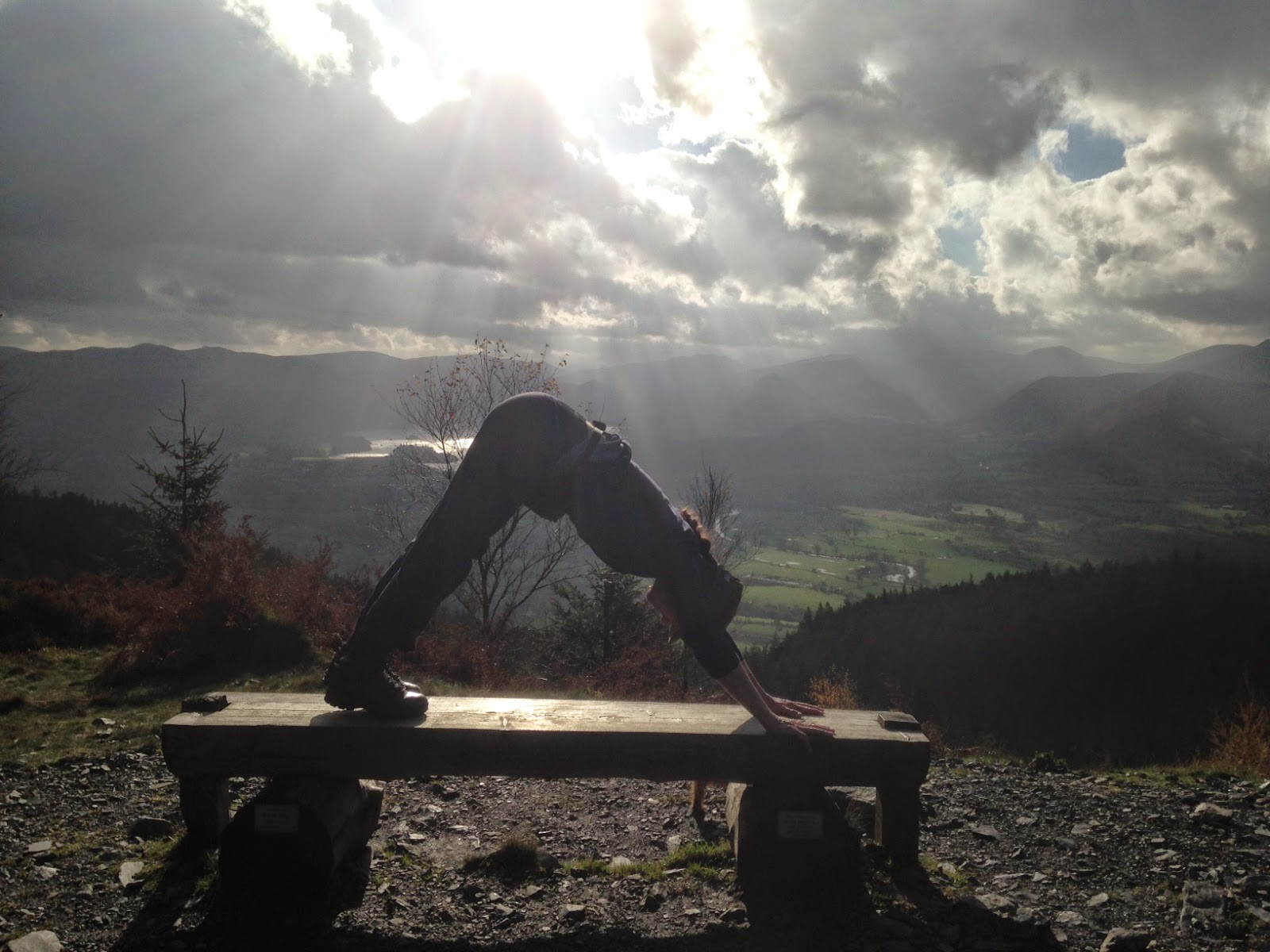
Down-Dog on Dodd

Up-Dog on Dodd

View over Bassenthwaite Lake

This Week I'm Growing...plants for next year

It's Tidy Up Time in the garden and as I cut back the Calendula and pull out the Cosmos I'm saving some seeds to sow in the spring.

The Calendula seeds look like this:


And the Cosmos seeds look like this:


Here's how to collect your own seed for free plants next year:

Choose a dry day to collect your seeds - soggy seeds will rot. Pick the dried flower and rub it between your fingers. The seeds will separate from the dried petals which you can discard. Leave the seeds in a warm place to dry out for a couple of days then put them into a paper envelope (so that any remaining moisture can evaporate), label them and store them somewhere cool and dry for the winter. The Calendula seeds can be sown in March as they are a hardy annual, and the Cosmos in April as they're not hardy and need milder conditions.


30 October 2014

Mindfulness - inside and out

Life can't always be about doing exciting, interesting things. Those boring, mundane chores that I keep putting off won't go away on their own so this week I am attending to them, and trying to do so mindfully and with acceptance rather than resentment. 

Thich Nhat Hanh is a Vietnamese Buddhist monk who teaches mindfulness. He encourages us to be aware and present in every moment, even when we are washing the dishes. It sounds like a simple thing to do but it really isn't easy. My mind keeps jumping here and there, thinking of other things I "should" be doing or going off into a daydream. Staying present is a challenge but, like he says in the quote below, I smile, breathe and go slowly and everything feels a little easier.  

I'm trying to think of the chores (scrubbing marks off the walls in the hallway, clearing out the cupboard under the stairs and cleaning behind the fridge - yuk! ) as ways in which I am taking care of my home. I'm grateful that I have a warm and comfortable place to live so it actually feels quite good to look after it in a conscious way. 
  

Thich Nhat Hanh has written many books about bringing mindfulness into your everyday life. Take a look here on Amazon - they're short and easy to read and will be a helpful addition to your library and the quest for peaceful living.


This Week I'm Visiting...nowhere in particular - just going outside

In keeping with my mindfulness practice indoors, I'm being more mindful on my dog walks too. Although I've walked on Bookham Common many, many times there is always something new to see. It's easy to hurry round, head down, thinking of all the things on the To Do list. But if you stay present you'll find some magic. Today my magic was seeing a Kingfisher! A flash of iridescent blue as it flew across the path in front of me! I've only seen one once before in my whole life and it felt very special to see it today. I wasn't quick enough to get a photo but I did take some of other magical things I noticed on my walk:


The glowing red leaves of Cotinus (Smoke Bush)

Fluffy seedheads of wild Clematis

Yellow berries of Sorbus (Rowan tree)

Tiny white flowers of an unknown umbel (Cow Parsley perhaps?)

The fabulously intricate architectural shape of a Teasel (Dipsacus)
  
Autumn colours on Bookham Common

The amazing and unexpectedly pink berries of 
our native Spindleberry (Euonymus europaeus)

I've added a photo too of one of my borders which is still in full flower as we go into November! Although it is collapsing a little and I'd really like to tidy it up I'm leaving it because it is still alive with bees. When the sun shines the butterflies are enjoying it too and yesterday there was a Hummingbird Hawk Moth feeding there for ages. I really don't like moths but I watched it from a safe(!) distance and it was completely fascinating. It was really big and I could see it's long probiscus going down into the flowers to search for nectar. I've added a photo from Google of one of these creatures because they are so intriguing - they really do look like hummingbirds!

Calendula, Fuschia, Dahlia and 7ft tall Cosmos


A Hummingbird Hawk Moth
.
These amazing things are all around us and will enrich our lives if we'd only remember to look for them. When we do notice them they can bring a rather gloomy grey day into glorious technicolour. 


This Week I'm Making...Super Speedy Porridge

Autumn is here so it must be time for porridge. Hooray! It's such a great way to start the day, easy, tasty and filling. I've tried lots of different variations and am currently loving this one from my favourite food blog www.deliciouslyella.com with bananas, almond butter, seeds raw chocolate(!), and raspberries.


This Week I'm Growing...Wallflowers

Although Thich Nhat Hanh reminds us to be in the present moment, the gardener must look to the year ahead and plant the spring bulbs and flowers now! It is exactly the right moment to go to the garden centre and buy some bare-rooted wallflowers. Plant them immediately in the border or in pots, water them well and leave them to grow quietly through the winter. They'll look a bit tatty for a while but they will bush out and then burst into flower in late spring. They come in various colours, are sweetly scented and I think they look especially wonderful when grown amongst Forget-Me-Nots. Bare-rooted (ie. not planted in soil in a pot, just bunched together with their roots showing) is the cheapest way to buy them but they're only sold like this for a very short window of time - go get some now!  


I've enjoyed looking for, and sharing, the little gems of magic that I found in my ordinary day. Can you let me know in the Comments section where you find inspiration and wonder in everyday life? 

20 October 2014

5 Signs You're Getting Better At Yoga & Life


In my private yoga sessions, clients are always wanting to know, "WHEN?"
When will their hips open up, when will they be able to touch their toes, when will they be more flexible, open, strong, etc. The funny thing is that they ARE more open, more flexible, more balanced and strong, than when we first started working together — they just don’t realize it. Enter the role of a yoga teacher.

In yoga psychology, we talk about the importance of having a teacher for many reasons. Students often can’t see for themselves, the progress they have already made, for instance. We all tend to become so focused on the end goal — where we’re trying to get, what we’re trying to cultivate and how we aren’t “there” yet — that we often don’t notice just how far we’ve already come.

More so, it is important to remember that big changes just don't happen overnight. Small incremental changes take place every time you step onto your mat; so small that you may not even notice until maybe one day you’re magically deeper into a pose, without even realizing it. But as the teacher, I can see how much my students’ bodies have changed or their understanding or perspective has shifted — and I make it a point to tell them so as a reminder.

Sure, we all want to feel accomplished; to realize we’ve made progress, and to know that we are getting something out of the work we’re putting in. In our yoga practice, we often focus on the physical progress, committing ourselves to working on certain poses or gaining more strength or flexibility, and then feeling accomplished when we experience a breakthrough. But that is just one sliver of the growth to be had by practicing yoga regularly.

Yoga as a spiritual path is about cultivating our inner self as much as (or more than) our outer practice. It’s about balancing our inner and outer worlds — discovering our true selves so that we can act in integrity from our place of truth in everything that we do. The true measure of your yoga practice is not whether or not you can do more advanced postures, but how you treat others, as well as yourself — the kind of person you are and the life that you want to lead.

Asanas aside, here are five signs that you’ve already made progress on the path through your yoga practice, and deserve a pat on the back:

1. You feel and notice more.
The practice of yoga, whether it’s asana, pranayama, self-study or meditation, expands your awareness levels — you will feel and notice more. You’re more aware of the way your body feels in a pose and can make the appropriate adjustments, and you notice the subtle differences between the two sides of your body. You’re conscious of when thoughts and emotions arise, and you often catch yourself when you're not paying attention more readily. You’re more sensitive to the subtle shifts that take place throughout your practice, and rather than falling into unconscious patterns, you know what you’re doing and why, by making conscious choices in all aspects of your life.

2. You respond rather than react.
Rather than being jerked around by your reactions, you begin to choose your response to certain situations or triggers, more consciously. You’re less impulsive and more deliberate with your actions. On the mat, you choose to stay in the poses longer by taking a few more deep breaths, instead of exiting out of the pose the moment your conditioned mind tells you it’s too difficult. Working with the breath, you begin to recognize that you are indeed stronger than your mind will ever allow you to think.

3. You’re willing to be uncomfortable.
Along with holding the poses longer, you’re willing to take more risks on and off the mat. Perhaps when you first started, you weren’t ready to attend class solo, and now have no problem walking into a studio where you know no one. Or maybe the thought of going upside down scares you half to death, but now you’re willing to give it a try under the guidance of a trusted teacher. Through yoga, you become more familiar with being uncomfortable and are more willing to put yourself out there, by trying new things and standing firmly in your truth.

4. You’ve stopped judging yourself.
Well maybe not completely, but that critical inner voice isn’t quite as loud as it once was. You don’t automatically judge every time you jump forward to the top of your mat, or critique every pose. You allow for imperfection! You no longer let one challenging arm balance undermine your entire practice, either. You’ve also stopped comparing yourself to others in class and can appreciate working and doing your best wherever you’re at.

5. You actually like Savasana.
Believe it or not (perhaps you even remember when!), Savasana is a challenging pose for most beginner yoga students. Many aren’t accustomed to lying still with their eyes closed for any length of time. Yoga teaches us how to sit quietly with ourselves and turn inward. Actually being able to allow yourself to stay comfortably in Savasana, is progress on the path. 


This Week I'm Making... Gluten-Free Bread and Gluten-Free Crackers

I've been eating a mostly gluten-free diet for the last 7 weeks now (and I'm feeling good on it :-) ) and I'm enjoying experimenting with some creative and forward-thinking recipes too. This one was recommended by one of my yoga students (thanks Claire). At first glance, the recipes look complicated, possibly because some of the ingredients might be unfamiliar, but it really is very simple and satisfying to make. I personally enjoyed the crackers the most as my bread was a little too moist, but I will try it again and adjust the amount of psyllium husks and water. 

Here's the link to the recipe - it's from a great healthy food blog called My New Roots   http://www.mynewroots.org/site/2014/07/the-life-changing-crackers/ and http://www.mynewroots.org/site/2013/02/the-life-changing-loaf-of-bread/ 


Ingredients for the bread and the crackers

My gluten-free crackers

My gluten-free bread with honey from Jackie S's bees 
(please overlook the large amount of butter! It's my indulgence! ;-)


This Week I'm Visiting...the poppies at the Tower of London

Last Saturday afternoon I stood in the glorious sunshine and took in the sight of the poppies at the Tower of London. If you haven't heard of this event/installation/phenomenon here's a couple of paragraphs from the Tower of London's website which explains it:

"Don't miss the major art installation Blood Swept Lands and Seas of Red at the Tower of London, marking one hundred years since the first full day of Britain's involvement in the First World War. Created by ceramic artist Paul Cummins, with setting by stage designer Tom Piper, 888,246 ceramic poppies will progressively fill the Tower's famous moat over the summer. Each poppy represents a British military fatality during the war.

The poppies will encircle the iconic landmark, creating not only a spectacular display visible from all around the Tower but also a location for personal reflection. The scale of the installation intends to reflect the magnitude of such an important centenary creating a powerful visual commemoration.

We are hoping to sell all of the poppies that make up the installation and, in doing so, raise millions of pounds which will be shared equally amongst six service charities."

Viewing the display was a poignant and moving experience, bringing home the enormity of the losses. It is an outstanding tribute to the 888,246 soldiers and a triumph of creativity, patience and teamwork. 

The display is on view until 11th November, after which the poppies will be carefully removed, cleaned and posted to those who have bought them. You can find more details here at http://poppies.hrp.org.uk/.


This Week I'm Growing... Narcissi - one of the first spring bulbs

I'm feeling super-organised as I plant my first bulbs for spring 2015. I've chosen Tete-a-Tete as they're easy to grow, reliable and good value. They're tiny little daffodils that bring lots of colour to a bare early spring border, although I've planted mine in pots for impact on my patio. They cost £2.49 for 15 bulbs from Wisley Plant Centre and are widely available at most garden centres at the moment. They can be planted any time up to the end of November but my advice (as learned from bitter experience) is to plant them as soon as you buy them because if you put them in the shed you'll forget about them! Get them planted up now and then there's nothing to do but wait for them to come up in all their glory in spring. They're happy to grow in most places except very damp soils where the bulbs will rot. Plant them pointy end up, 10cm deep and about 6cm apart, but if you're planting them in pots they can be squeezed in a bit closer for an eye-catching display.


A medium sized pot with drainage crocks at the bottom,
then  a layer of compost

Place the bulbs pointy end up on the compost then cover with about 10cm of compost,
 label and keep outside in a sheltered position where the compost won't dry out

The Tete-a-Tete daffodils will look like this in early spring


And Finally...

A video of Maya Angelou (1928-2014) reading her wonderfully uplifting poem "And Still I Rise"...